


Special Programmes & Events
Subgroup:

The Special Programmes & Events Subgroup assists other Subgroups in organising specific events-which are in addition to the regular Subgroups programmes . It also assists in the ASG Opening & End of Year Events/ and programmes that require contributions from members & guests.
Coordinator: Amber Parvez
Co-coordinator: Aliya Mansur, Shahwar Mohsin

Subgroup Programmes:

Special Programme/ Art: NIGI'S PALETTE
Sunday, 19 March 2023
An opportunity not to be missed- a special for art lovers!
Join us for an Open House invitation by Nigi Aziz. She will be showcasing her individualistic art work featuring oils, water color and stained glass on mixed mediums... and then refreshments on the beautiful rooftop garden!
Modeled after a similar concept in Monterey, California, where artists open their houses to the general public to see their paintings hanging in their own homes, this is a unique experience for both the guests and the artist...
Nighat Kamal Aziz (Nigi) is an artist and a columnist. Her articles have been published in the op -ed pages of local & international magazines.Apart from Islamabad, she has held a number of art exhibitions in Berlin where her spouse served a couple of stints, most recently as the Defence Attaché.
- Nigi’s Palette on Instagram: @nigiaziz

Special Programmes-MURREE BREWERY (RAWALPINDI) - AN EXCLUSIVE TOUR
Saturday, 11 March 2023
Self-Drive- Drive in convoy
Please Note:
- NOC's essential for foreigners; kindly submit by Monday, 6th March 2023.
- Diplomats: A PERMISSION NOC has to be requested at least 10 business days ahead of time. This is different from the routine notification NOC required for other non-restricted places.
- Apply well in advance to avail of this rare & exclusive opportunity to visit Pakistan’s historic brewery!
- Deadline for submission:Monday,6 March 2023.
One of the oldest public companies of the Sub-continent, it is also the oldest continuing industrial enterprise referred to as "The Murree Brewery Company Ltd".
The Ghora Gali Brewery was among the first modern businesses established in Asia in 1860 near Murree, which then, was the most popular resort. The products of the Brewery were popular among the British troops who were largely barracked in the 'Galis' of these hills.
Brief history
Between 1885 & 1890 the Company established itself in Rawalpindi and Quetta and acquired an interest in the Oticumand (South India) and Norailiya (Ceylon) breweries. It was the first to be awarded a medal for product excellence at the Philadelphia Exhibition in 1876, followed by numerous awards over the past 140 years.The business was managed by the family of General Reginald Dyer. In the 1940s, the share in the enterprise was obtained by a Parsi gentleman, the late Mr. Peshton Bhandara. His son, the late Mr.M.P. Bhandara later carried on the business, and it is now being run by his grandson, Mr.Isphanyar Bhandara.
In 1935, a massive earthquake totally demolished the Quetta outlet as well as a substantial part of Quetta town, killing thousands of persons. In the 1920s, the activities were mostly transferred to Rawalpindi, but malting continued at the Ghora Gali outlet till the 1940s when the property was sold. This historic building built in Gothic-style architecture was burnt during the partition riots of 1947/48. The ruins are still visible as you drive up to Murree and have served as a backdrop to many Pakistani and some International films!
The current Murree Brewery is located in Rawalpindi.

Special Programmes & Events -A VERY SPECIAL 'PERSIAN INSTRUMENT' WORKSHOP WITH MOEZ ARYAN
Saturday, 3 December 2022
Immerse into the rhythm!
Persian music relies on both improvisation and composition.
This is a rare opportunity for you to participate in an exclusive percussion workshop with Moez Aryan,and experience the mesmerizing sounds of ancient persian instruments!
The upcoming session will focus on the biggest common denominator between all genres of music: percussion. Different beats and rhythms will be demonstrated /discussed- followed by an exciting hands-on practice with drums and the 'Duff' (Persian instrument) by the participants!
Moez is a self taught multi instrumentalist, playing various strings and percussions . He currently divides his time between teaching and performing music, and running his business. He has been a regular performer at solo events and fusion works all over the country since 2001.In 2020 founded Parvaaz ensemble with his friends. Parvaaz is a musical expression of Middle Eastern mystical, divine and devotional literature.

Special Programmes & Events - MUSIC: THE MAGIC AND MYSTIQUE
Sunday, 14 November 2021
Join us for an unforgettable musical experience !
'It is widely regarded that some Middle-Eastern musical styles have influenced the Subcontinent as well as Central Asia,Spain and the Balkans...’ .
As a Special Programme for ASG, Moez Ali - an exceptionally talented self-taught, multi-dimension instrumentalist of Persian descent, will - through his vast private collection of traditional instruments - both string and percussion - including the Persian Setar, Taar, Oud, Rubab, Tanbur, Tombak, and the Daf- introduce us to Middle Eastern music that spans across a vast region- from Morroco to Iran- each maintaining its own unique traditions...
Moiz has performed solo as well as fusion works, since 2001.
Recently, he has formed the very popular 'Parvaaz' ensemble which explores the mystical dimensions of ancient Persian repertories and fuses it with a modern touch...

Special Programme - THE ART OF BONSAI
Saturday, 30 October 2021
'BONSAI' (Japanese: "tray-planted") are living dwarf trees trained to grow in containers. Bonsai specimens are ordinary trees and shrubs, not hereditary dwarfs. They are dwarfed by a system of pruning roots and branches and training branches by tying with wire. The art originated in China, where, perhaps over 1,000 years ago, trees were cultivated in trays, wooden containers, and earthenware pots and trained in naturalistic shapes. Bonsai, however, has been pursued and developed primarily by the Japanese.
Bonsai may live for a century or more, and be handed down from one generation to another as valued family possessions. Medium or average bonsai can be produced in as little as three years whereas, small sized bonsai require 5 to 10 or more years to train.
The demonstration will include :
- Brief introduction of 'Root Over Rock' style.
- Tips for the selection of rock.
- Selecting the most suitable trees.
- Preparing a tree for the composition.
- A few short cut techniques that help create a composition in just a few years!
Abu-Bakar started on his own to experiment with this art in 1985. His Bonsai's have been greatly appreciated at Islamabad's horticultural events. In this program, he will briefly inform us about this art which will be followed by an interesting demonstration of techniques used to create a stunning Root-over-Rock Bonsai. We all have seen and admired trees clinging to high mountain clifs where their roots are spread over the rocks. Now imagine if we can replicate the same composition in miniature!

ASG OPENING EVENT
Thursday, 30 September 2021
Mark your Calendars!
OPENING EVENT 2021-2022
6.30 pm onwards
GUESTS WELCOME!
An opportunity for you to join the ASG or renew your membership at a special discount!
Purchase the limited edition of the 2022 ASG Calendar and other publications!
( In case of rain... move inside!- SOP's Essential)
‘THE FLOWERING DESERT: TEXTILES FROM SINDH’
A Multimedia presentation- Nasreen Askari
“Even now the antiquity of Sindh’s textiles tradition, which goes back to 5000 BC, is terribly under- exposed and not studied. It has been subsumed under a generic classification of Indian art and culture if it is appreciated at all…”
The presentation focuses on a private collection of textiles from Sindh, Pakistan, which, according to some scholars, was the crucible in which the textile traditions of Gujarat and Rajasthan were forged. Sindhi textiles are unique inasmuch as they reflect a dimension that combines the harshness of the terrain with a quest for a mythical and unattainable beauty. The collection is recognized as being of outstanding merit , it has featured in exhibitions at the Victoria and Albert Museum, London and the National Museum of Scotland, Edinburgh.
‘The Flowering Desert: Textiles From Sindh’ reveals an alternative narrative of the region best known abroad for the unruly, sprawling mass of its capital city, Karachi, and the drama of its most famous family, the Bhuttos….Fifty years of documenting Sindh’s visual history has culminated in a project for the wife & husband team- Nasreen and Hasan Askari, who ardently believe in the “soft power” of culture. By shining a light on the arts and crafts of its rural hinterland, they are aiming for reverence at home, for a tradition that has often been overlooked or dismissed…
About the Presenter: “My interest started quite a long time ago, sometime in 1970,I went from the privileged schools of Karachi to university in Jamshoro, a complete wilderness, I saw costumes and textiles I’d never seen before, through the motifs, colours and styles there were whole vocabularies communicated in whasaw. Within textile arts, Sindhi works stand very high. It’s just so little known and understood. The greatest strength is not just the skill but the authenticity. In a sense, I hope this will go some way to show that…’
Nasreen Askari is the Founder/ Director of the Mohata Palace Museum, Karachi. She is described as one of Pakistan’s most ardent cultural ambassadors. Her enthusiasm and reputation is unparalleled. She hopes that the traditional textiles from the province of Sindh will be appreciated- not just as quirky national heritage- but as art in their own right. She has dedicated her life’s work to the preservation and elevation of the bold, dramatic and painstaking embroidery and block prints of the artisans in Pakistan’s second biggest province.
Venue: Shamadan Lawn, Serena Hotel, Islamabad.(In collaboration with Serena Hotel)
For further information : ASG office 2802343 (Tue-Sat: 11am-2pm)/asianstudyg@gmail.com

Opening Event 2020-2021
Saturday, 17 October 2020
‘Rawul Pindee: The Raj Years’- a voyage through the mists of time… - Ali Khan
A multimedia Presentation
A sense of nostalgia prevails throughout the presentation for a bygone era as it evokes the Colonial period through a treasure trove of vintage photographs, long forgotten historical facts and figures that have shaped the history of Rawalpindi and its surroundings…..

Opening Event 2018-2019
Thursday, 4 October 2018
Concert: Khumariyaan – The Band ‘The Intoxication of Sound’

Opening Event 2017-2018
Thursday, 5 October 2017
The Magic and Power of Dance
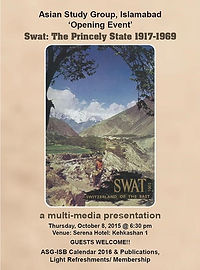
Opening Event 2015-2016
Thursday, 8 October 2015
Swat: The Priceley State 1917-1969 - Adnan Aurangzeb
A multimedia presentation
- 4Page 3